
Supplementary Information for Poster: Developing a Pragmatic Online Behavioural Intervention for Shift Work Disorder in NHS Staff (World Sleep Congress 2025)
Forrest Tin Wai Cheung, Rachel Sharman, Dimitri Gavriloff, Thavapriya Sugavanam, Leah Holmes, Annie Keane, Colin A. Espie, Amy C. Reynolds, David Ray, Simon D. Kyle
OxBIS Logic Model
| Treatment Components (Inputs) | Targeted Problems | Effect (Outputs) | Proximal Outcomes | Potential Distal Outcomes |
|---|---|---|---|---|
| Psychoeducation on Sleep, Circadian Rhythm, and Shift Work | ALL | Increase knowledge & awareness Debunk misconceptions Reduce shift work related anxiety |
↓ Anxiety ↑ Self-efficacy |
Improve quality of life Improve psychosocial well-being and physical health Reduce road traffic accidents Reduce work-related mistakes and accidents Reduce healthcare utilisation |
| Sleep Scheduling and Anchoring | Insomnia Sleepiness |
Optimising sleep opportunity Address obstacles in prioritising sleep |
↑ TST, SE ↓ Daytime sleepiness ↑ Sleep experience ↑ Self-efficacy |
|
| Sleep Hygiene Education | Insomnia Sleepiness |
Increase knowledge & awareness Improve sleep environment |
↓ SOL ↑ TST ↓ Arousal |
|
| Psychoeducation on Light and Alertness | Sleepiness Desynchronised rhythm Trouble concentrating |
Increase knowledge & awareness Reduce shift work related anxiety |
↓ Daytime sleepiness ↑ Alertness ↓ Post-shift sleep SOL ↑ SE ↑ Self-efficacy |
|
| Strategically-timed Light Exposure and Avoidance | Sleepiness Desynchronised rhythm Trouble concentrating |
Increase knowledge & awareness Increase adaptation to circadian rhythm Promote sleep/alertness |
↑ Alertness ↓ Post-shift sleep SOL ↑ SE |
|
| Lifestyle Modification for Circadian Adaptation (diet, physical activity, napping) | Sleepiness Desynchronised rhythm Trouble concentrating |
Align peripheral and central circadian clock Increase positive health behaviour |
↓ Daytime sleepiness ↑ Alertness ↓ Post-shift sleep SOL ↑ SE |
|
| Stimulus Control | Insomnia | Increase knowledge & awareness Reduce time in bed awake Improve adherence to sleep schedule |
↓ SOL ↑ SE ↓ WASO ↓ Cognitive arousal |
|
| Psychoeducation on Stress and Arousal | Insomnia Stress / Arousal |
Increase knowledge & awareness | ↑ Self-efficacy | |
| Cognitive Strategies (cognitive defusion) | Insomnia Stress / Arousal Sleep-related worries |
Reduce distress Improve emotional regulation Increase knowledge of problem-solving Increase psychological flexibility |
↓ Arousal, worries, and stress ↓ SOL ↓ WASO ↑ SE |
|
| Relaxation Training | Insomnia Stress |
Reduce distress | ↓ Arousal, worries, and stress ↓ SOL |
|
| Social and Communication Skills Training | Impaired social functioning | Increase knowledge Improve social/interpersonal skills |
↑ Self-efficacy ↓ Stress |
Protocol for the Feasibility and Acceptability Trial
Study Objectives
- To assess the feasibility of a future clinical trial
- To assess the acceptability of the intervention on experiences of implementation, impact and suggestions for refinement of the intervention and research procedures
- To assess whether the treatment acts to change cognitive and behavioural targets
- To explore the use of services and resources
Methodology This is a single-arm, mixed-methods feasibility and acceptability study.
Participants: 30 NHS shift workers with suspected shift work disorder (SWD), as determined using the shift work disorder index (SWDI) and clinical interviews, recruited from two Oxford NHS Trusts.
Eligibility:
- Inclusion: Aged ≥18, employed by the NHS, working non-standard hours (≥1 evening/night shifts per week for ≥3 months), and meeting criteria for SWD (insomnia and/or sleepiness due to shift work, with associated distress or impairment)
- Exclusion: Sleep problems explained by other health conditions, current formal treatment for insomnia, untreated comorbid sleep disorders, severe psychiatric diagnoses (e.g. bipolar, schizophrenia), dementia, current suicidal ideation with intent, pregnancy or major planned surgery, ongoing cancer treatment, inability to understand English or comply with procedures, and non-NHS employed staff.
Procedure: There are two stages of screening. First, an online questionnaire is completed by interested individuals, followed by a structured interview conducted by an assessor to confirm a diagnosis of SWD and exclude any contraindications.
Intervention: Six OxBIS sessions every two weeks, each around 60–90 minutes. The interventions are delivered by trained NIHR research nurses.
Assessments:
- Baseline and post-intervention questionnaires on insomnia severity, daytime sleepiness, fatigue, quality of life, depressive symptoms, pre-sleep arousal, sleep hygiene behaviour, and work functioning.
- 14-day sleep measures using sleep diaries and actigraphy and continuous under-mattress sensor monitoring for the entire duration of the study.
- Semi-structured interviews with ~15 participants and ~5 facilitators to explore acceptability, experiences, and suggestions for refinement.
Feasibility Assessment
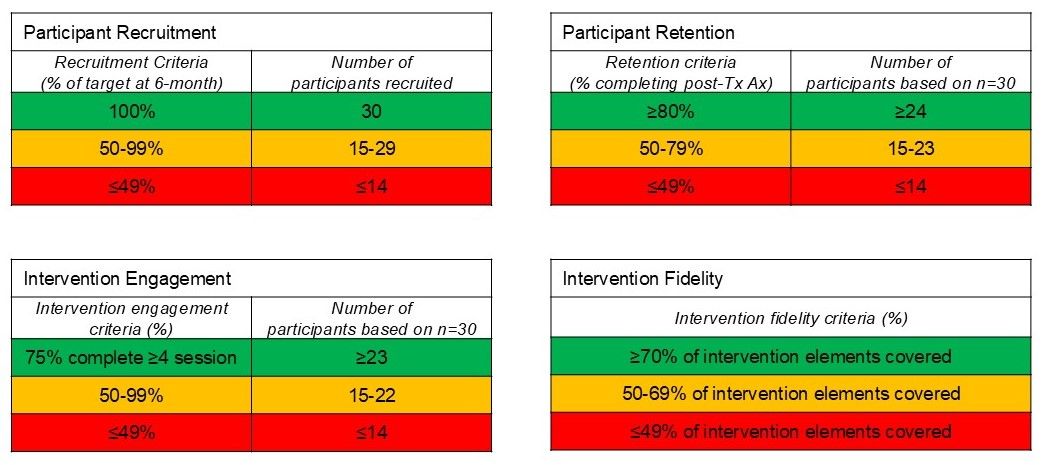
A traffic light system (“stop-go”) will be used to decide whether pre-specified progression criteria have been met and whether we can proceed to a larger trial without modifications (green), proceed to a larger trial after having made amendments for remediable issues (amber), or to stop and not progress to a larger trial (red).
Link to trial registration (ISRCTN86601865)
Acknowledgement
We thank the NHS Nightshift Workers Research Advisory Group members, Nicky Barnes, Harriet Nancy Byogero, Caroline Cole, Arlene Garen, Ben Langhorne and Louise North, for their time and insights.
This work was supported by the National Institute for Health and Care Research (NIHR) Programme Grants for Applied Research (Ref: NIHR203667). RS and SDK are supported by the NIHR Oxford Health Biomedical Research Centre grant (Ref: NIHR203316).